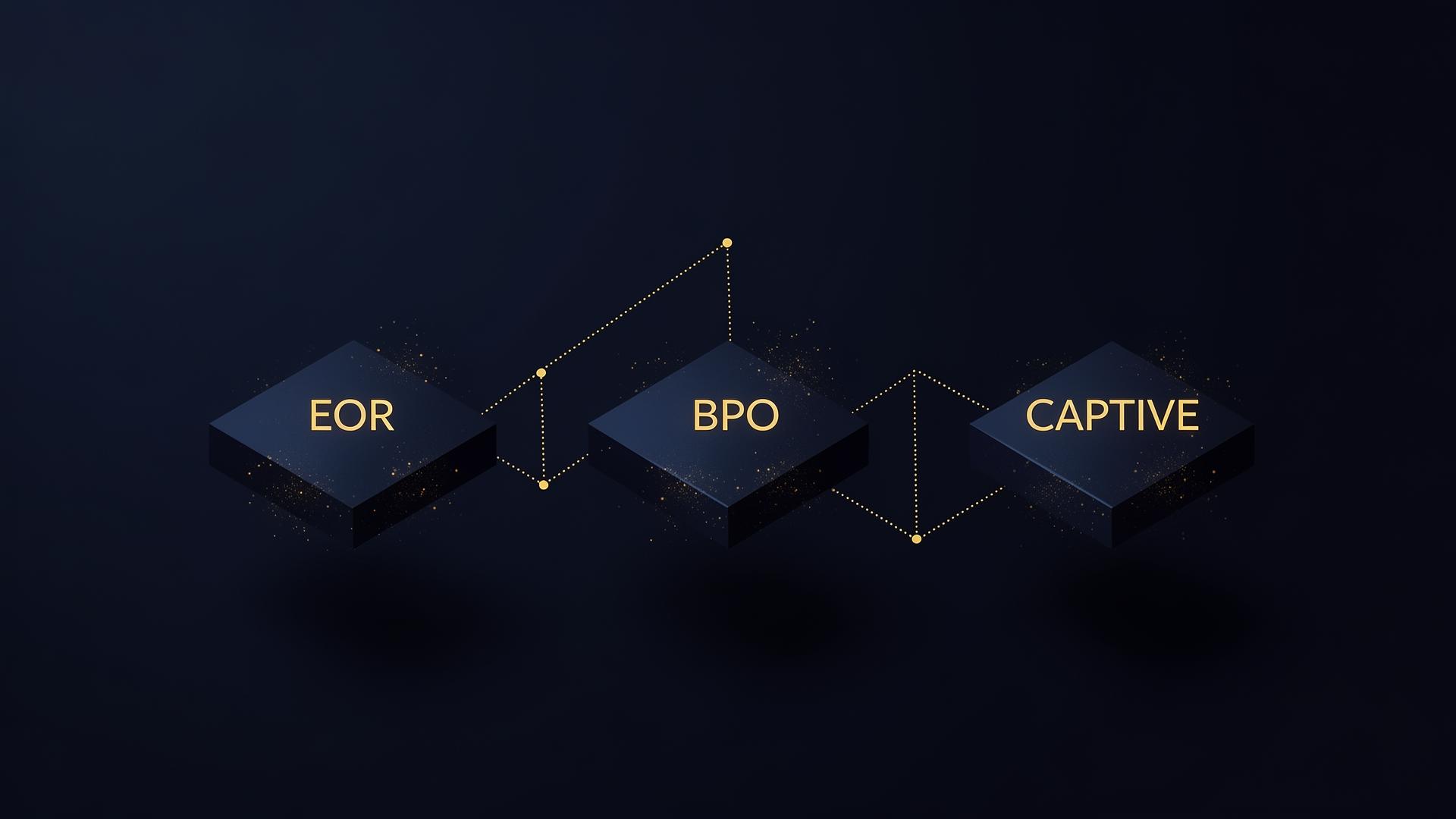
The Best Outsourcing Model in 2026: Why EOR Beats BPO and Captive for Validation
Choosing between EOR, BPO, and a captive center is the single most expensive decision in your offshore strategy. Here is the framework smart operators use to validate destinations before committing capital.
Most offshore guides tell you to "build your dream team in [country]." That advice has bankrupted more US companies than it has scaled. The smart move in 2026 is not to commit, it is to validate first, commit later.
This guide breaks down the three real outsourcing models, the hidden cost of each, and why Employer of Record (EOR) has quietly become the fastest, lowest-risk way to test a destination before you invest a dollar in a captive office.
TL;DR: Which Model Should You Actually Pick?
| Stage | Best Model | Time to Launch | Upfront Cost | Risk |
|---|---|---|---|---|
| 0 to 3 months: validating the destination | EOR | 2 to 3 weeks | Near zero | Very low |
| 3 to 12 months: scaling a proven function | Managed BPO | 4 to 8 weeks | Low | Low |
| 12+ months, 50+ FTEs, core function | Captive (own entity) | 6 to 12 months | $80k to $250k | High |
If you skip the validation stage, you will likely either pick the wrong country, the wrong process to outsource, or the wrong vendor structure, and find out 9 months and $400k in.
What Each Model Actually Is
1. Employer of Record (EOR)
A third party legally employs the worker on your behalf in the foreign country, handles payroll, taxes, benefits, and compliance, while you direct the work day to day. You do not need a local entity. Think of it as "renting" a foreign hire.
- You control: hiring decision, scope of work, performance management, daily direction
- EOR handles: legal employment, payroll, social insurance, statutory benefits, terminations
- Time to first hire: 2 to 3 weeks
- Cost structure: salary + 15 to 25% EOR fee on top
- Best for: testing 1 to 10 hires in a new country, hiring a single key role abroad, validating before captive investment
2. Managed BPO (Business Process Outsourcing)
A vendor provides trained agents, infrastructure, supervision, and reporting against agreed SLAs (Service Level Agreements). You buy an outcome (handled tickets, qualified leads, processed claims) rather than headcount.
- You control: scope, KPIs, quality bar, escalation path
- BPO handles: recruiting, training, workspace, equipment, attrition, supervision, technology
- Time to first agent live: 4 to 8 weeks (faster for experienced verticals)
- Cost structure: per-seat or per-transaction monthly fee
- Best for: scaling proven functions, accessing trained talent pools fast, when you do not want to build management infrastructure
This is what AB Business Services does for clients across healthcare, real estate, and SaaS.
3. Captive Center (Your Own Foreign Entity)
You set up your own legal entity, lease office space, hire directly, build local HR, IT, and management. The team is 100% yours.
- You control: literally everything
- You handle: entity formation, local labor law, payroll, benefits, recruiting, IT, real estate, legal, taxes, terminations
- Time to launch: 6 to 12 months
- Cost structure: $80k to $250k upfront + ongoing overhead
- Best for: 50+ headcount in a single function, IP-sensitive work, multi-year strategic commitment
The Hidden Costs Nobody Tells You About
The sticker price never tells the real story. Here is what each model actually costs once you account for failure modes.
| Hidden Cost | EOR | BPO | Captive |
|---|---|---|---|
| Wrong-country risk | Walk away in 30 days | Contract exit, 30 to 90 days notice | $80k+ sunk |
| Wrong-vendor risk | N/A (you hired the person) | Switch vendors in 60 days | N/A |
| Attrition replacement cost | Recruit yourself, 4 weeks down | Vendor handles it, ~1 week | You handle it, 6 to 12 weeks |
| Management bandwidth | High (you manage the person) | Low (vendor manages) | Very high (you run an office) |
| Compliance landmines | EOR absorbs | BPO absorbs | All on you |
| Currency / FX exposure | Minimal | Vendor absorbs | Full exposure |
| Cultural mismatch discovery | Week 2 | Week 4 | Month 6, after $200k spent |
The captive model looks cheapest on a per-FTE basis at scale. It is by far the most expensive when you factor in the probability that the destination, the process, or the leadership team is wrong. EOR is the cheapest insurance policy in offshore.
The Validation-First Playbook
Here is the sequence smart operators use in 2026:
Phase 1: Validate the Destination (Weeks 1 to 8) — Use EOR
- Pick 2 candidate countries based on cost, timezone, English proficiency, and your specific function
- Hire 1 person per country via EOR for the same role
- Run them in parallel for 6 to 8 weeks
- Score them on: output quality, communication, accent neutrality, punctuality, cultural fit, attrition risk
You will learn more in 8 weeks of EOR than 6 months of vendor proposals. Worst case, you spend ~$8,000 and walk away with clarity.
Phase 2: Scale the Function (Months 3 to 12) — Use Managed BPO
Once a destination wins, you do not want to recruit, train, retain, and manage 10 more hires yourself. That is the BPO's entire job. Hand the function over to a managed BPO with a clear SLA. You get scale without management overhead.
This is the sweet spot for 80% of US companies. Most never need to leave this phase.
Phase 3: Build a Captive (Year 2+) — Only If It Makes Sense
Build a captive only when:
- You have 50+ FTEs in a single function in a single country
- The function is core IP and you cannot share it with a vendor
- You have proven leadership willing to relocate or commit long-term
- Your CFO has run the numbers and EOR + BPO blended cost exceeds captive TCO by 30%+
If those four boxes are not all checked, stay in BPO. Captive is a status symbol, not a strategy, for most companies.
Why Egypt Is the Best EOR / BPO Destination to Test in 2026
If you are picking destinations to validate, here is why Egypt deserves to be on your shortlist:
- Timezone: GMT+2/+3 means 3 to 8 hours overlap with US business hours, with night-shift agents covering full US coverage
- English proficiency: EF EPI ranks Egypt highest in the Middle East and Africa region for English skill
- Cost: typical fully-loaded BPO seat is 40 to 70% cheaper than US, often 10 to 20% cheaper than the Philippines for equivalent quality
- Talent pool: 700,000+ university graduates per year, large pool of English, French, German, Italian, and Arabic speakers
- Compliance: HIPAA, ISO 27001, and SOC 2 vendor frameworks are well-established locally
See our full pricing comparison to model your specific savings.
Common Mistakes to Avoid
- Skipping validation: signing a 12-month BPO contract before testing the destination
- Using EOR for everything: EOR is great for 1 to 10 hires, brutal for 30+ (management overhead crushes you)
- Building captive too early: the #1 reason offshore programs fail
- Picking based on lowest sticker price: quality and retention matter 10x more than $2/hour savings
- Treating offshore as set-and-forget: vendor or captive, you need a US-side owner accountable for the relationship
Bottom Line
The "best" outsourcing model depends entirely on what stage you are in:
- Validating? Use EOR. 2-week setup, near-zero risk.
- Scaling a proven function? Use a managed BPO like AB Business Services.
- Strategic 50+ FTE play with airtight numbers? Build a captive.
The mistake is committing capital before you have data. Validate, scale, then own.
Ready to validate Egypt as your offshore destination? Request a custom pricing model and we will show you exactly what your function would cost, with side-by-side US vs Egypt economics. Or talk to our team about a 30-day pilot.